

The Chief Transformation Officer: Architect of Consistency
- Jun 8
- 5 min read
Look at any organization in the midst of a digital transformation: the CIO is pushing for IT modernization, the CDAIO is building a data platform, the CDO is launching a new omnichannel customer experience program, the COO is deploying RPA robots, and the CISO is putting the brakes on half of these initiatives. Everyone is working. No one is working together.
This is precisely where the Chief Transformation Officer (CTrO) comes in: as the architect of alignment among all the other C-level executives.
The CTrO is the architect of coordination
The first mistake I encounter with my clients is confusing the CTrO with a glorified PMO. The CTrO does not manage projects; he or she governs a transformation. A PMO tracks milestones. The CTrO aligns visions. A PMO escalates risks. The CTrO mediates conflicting priorities among legitimate leaders, each defending their own turf. A PMO reports. The CTrO commits.
Concrete example: In a major banking network, a transformation project simultaneously involved the consolidation of three business applications (CIO), the implementation of a predictive scoring model (CDAIO), the redesign of the advisor portal (CDO), and the handling of sensitive data (CISO).
Without a CTrO to establish a common sequence, each team optimized locally, and the four projects proceeded according to their own priorities. The intervention of a cross-functional orchestrator reduced time-to-market by 8 months.
We are indeed talking about a system where there is no “program” in the organizational sense: these initiatives arose separately and are not coordinated. Yet it is clear that they will make more sense together, and indeed that they can be enriched by their own cross-functional nature. Managing this cross-functionality is necessary for value creation.
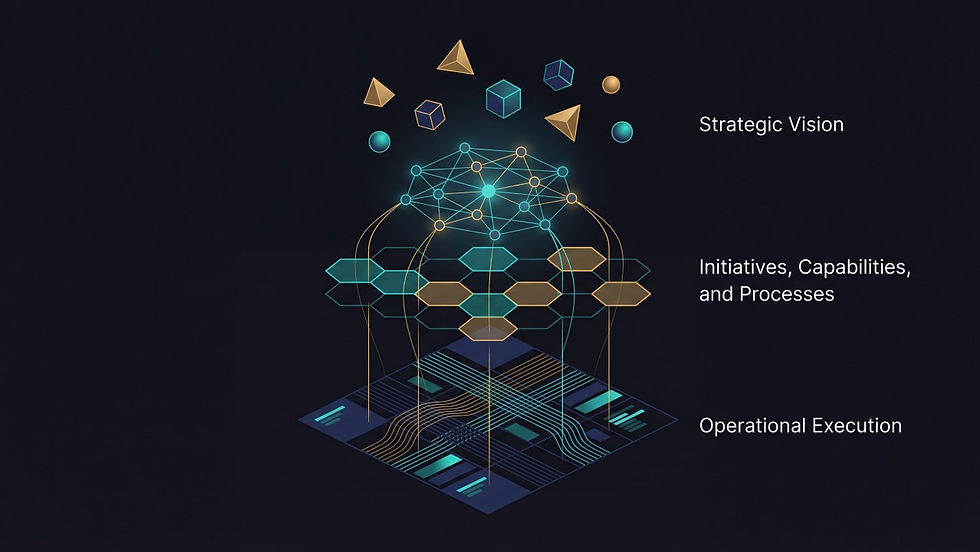
The very concept of transformation stems from this. It enables local pockets of transformation to be guided toward macro-level coherence, which influences strategy while aligning with it.
This is clearly not the role of a PMO. It might be that of an enterprise architect, but they too often report to the CIO, and they generally lack the mandate to claim this type of detection, analysis, and alignment, even if their job description might suggest otherwise.
The seven C-suite roles and their relationship to the CTrO
The CEO (Chief Executive Officer) defines the “why” of the transformation. The CTrO translates this ‘why’ into an organizational “how.” The CEO-CTrO relationship is that of a principal and an agent: the CEO sets the ambitions; the CTrO ensures their feasibility and execution.
The CFO (Chief Financial Officer) is often underestimated in transformation programs. They are not there to say no - they are there to ensure that every “yes” is financially sound. A good CTrO involves the CFO very early on: transformation business cases are co-developed, not presented after the fact.
The COO (Chief Operating Officer) is the embodiment of realism. He is the one who knows that frontline teams need six weeks of training before switching to a new system, not two as the IT team hopes. The CTrO must rely on the COO to fine-tune deployment plans and trust him regarding operational warning signs.
The CIO (Chief Information Officer) is the primary technological steward of the transformation. The CTrO-CIO relationship is often the most complex, as the two roles may seem redundant (see the role of the enterprise architect). Yet the dividing line is clear: the CIO is responsible for the “technical how,” while the CTrO handles the “strategic what and when.”
In practice, the CTrO must avoid micromanaging the IT architecture: their role is to validate that architectural choices support the transformation trajectory, not to impose them.
The CISO (Chief Information Security Officer) provides the safeguards. In a context of increasing regulation (GDPR, DORA, AI Act, ISO 42001), the CISO is no longer a hindrance; they are a competitive advantage. Companies that integrate security from the very design of their transformation programs (security by design) avoid costly overhauls down the line.
The CTrO must create the conditions for a proactive, not reactive, CISO dialogue.
The CDAIO (Chief Data and Artificial Intelligence Officer) is the lever for acceleration.
Artificial intelligence and data are no longer IT projects, they are cross-functional strategic capabilities.
A CDAIO who is closely aligned with the CTO can identify, within any transformation program, where AI creates a differentiating advantage: automating a validation workflow, detecting anomalies in a management control process, or personalizing a customer journey. Without this connection, AI remains confined to its “innovation” silo and does not permeate operational programs.
The CDO (Chief Digital Officer) is the ambassador for the customer experience in transformation. Too often, transformation programs are designed “from the inside out”: internal processes are optimized without asking whether the end customer perceives the value. The CDO reverses this logic. The CTrO must ensure that every transformation program has a “customer-facing” component led by the CDO.
The Mechanics of Interactions: Avoiding Territorial Conflicts
The most common issue in C-suites undergoing transformation is territorial conflict. The CDAIO wants to oversee the data platform, but the CIO wants to retain control over the infrastructure. The CDO wants to launch a mobile app, but the CIO says the API isn’t ready. The CISO blocks a cloud deployment that the CIO has approved.
The CTrO is the architect of convergence. Their method:
Build a balanced transformation strategy, balancing innovation and regulation, quick wins and asset sustainability, state-of-the-art technology and the organization’s unique culture.
Establish a shared vision that every C-level executive can embrace as their own
Define clear areas of responsibility with explicit interfaces
Create synchronization rituals (weekly transformation committee, monthly portfolio review)
Value interdependencies rather than denying them
Example — retail: A retail group was simultaneously rolling out a logistics IT system overhaul program (CIO + COO) and a customer application customization program (CDO + CDAIO). Both programs shared the same product database. Without common governance, each team had created its own view of this database—with major inconsistencies. The CTrO established a formal “data contract” between the two programs, defining who produces the data and who consumes it. Result: an end to mutual blockages and a 40% reduction in production anomalies.
What the absence of a CTrO reveals
The signs that an organization lacks a Chief Transformation Officer are recognizable:
Transformation programs are managed in silos, with separate financial reports
The CEO spends more than 20% of their time mediating disagreements among C-level executives regarding prioritization
Projects consistently exceed budgets because inter-team dependencies are not anticipated
The concept of “transformation” is diluted: each director calls their functional roadmap “transformation”
The steering committee is a reporting meeting, not a decision-making one
Conclusion: Transformation is a team effort
Digital transformation has led to an inflation of C-level roles: CIO, CDO, CDAIO, CISO. They are all legitimate and necessary, but this raises the issue of consistency. Only a role dedicated to cross-functional orchestration can transform a set of parallel roadmaps into a convergent transformation program.
The Chief Transformation Officer is not the most visible member of the C-suite, but it is precisely this lack of desire for the limelight that makes them the essential cog in an organization.


Comments