

Change is an ongoing skill
- Jun 8
- 4 min read
88% of business transformations fail to meet their initial goals (Bain, 2024). Organizations invest millions, mobilize teams, hire consulting firms… and end up back where they started. What if the problem isn’t the transformation itself, but the way it’s designed?
Transformation is no longer an option
Any company that waits for ideal conditions to transform is waiting for its own obsolescence. Markets no longer give advance warning. AI is reshuffling the deck in a matter of quarters. Customer expectations are constantly evolving. Regulation is accelerating: the EU AI Act, DORA, NIS2. Standing still means falling behind.
The question is no longer whether your organization needs to change, but whether it is culturally capable of doing so. Because transformation cannot be decreed in a presentation to senior management. It must be lived, or it fails. And when it fails, it is almost never for technical reasons.
Studies have consistently shown over the past decade: the failure of transformations is primarily human. Silent resistance, change fatigue, the feeling of being a guinea pig rather than an active participant - these are the real obstacles. 91% of French companies report having encountered difficulties in their digital transformation process (Zoho, 2024). The technology was often there. The people, less so.
Transformation is ongoing. We might as well accept it.
The great illusion of management over the past twenty years has been to treat change as a project: a beginning, an end, a budget, a review. We roll out an ERP system, we “manage the change,” and we move on to something else. That model is dead.
We have entered the era of perpetual change—not as a crisis to be weathered, but as the normal state of high-performing organizations. McKinsey has demonstrated this: a successful digital transformation can increase a company’s operating profit by 40%. But this advantage is never permanent. It must be continually reclaimed.
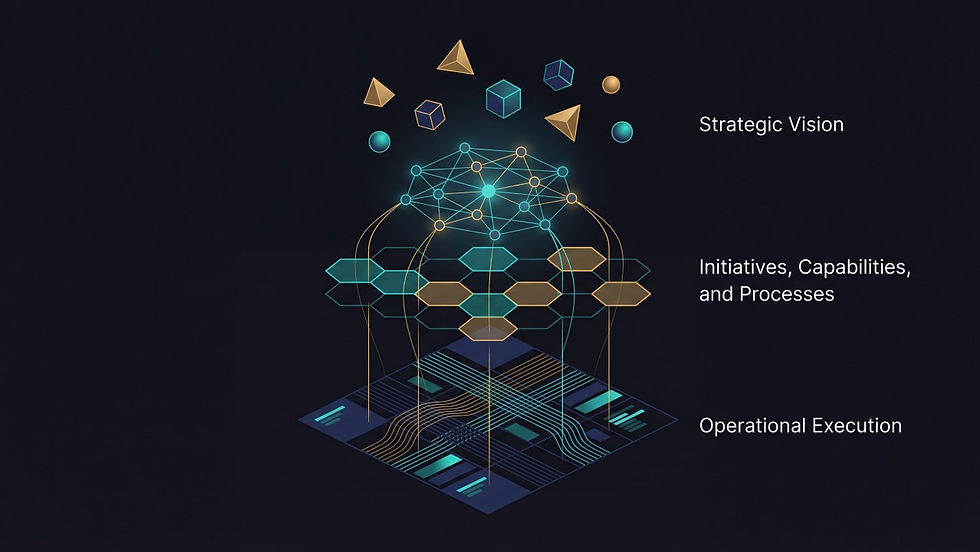
This paradigm shift is fundamental: it is no longer transformation that must be managed on an ad hoc basis; it is the capacity to change that must be built structurally. The learning organization is not a theoretical ideal, it is the only viable response to an environment that will never stabilize.
This requires giving up a certain comfort: that of the grand five-year plan, the fixed master plan, the technological “big bang.” Constant change is managed in small steps. Regular adjustments, short experiments, rapid learning. A logic of continuous improvement rather than periodic revolution.
AI increases and reveals your capacity to change
Artificial intelligence is not merely an object of transformation. It is gradually becoming a lever to drive it.
In the field, AI already enables real-time identification of subtle signs of resistance within teams, analysis of adoption patterns for new tools, and the customization of support pathways based on actual profiles and behaviors, not HR assumptions. It can generate impact simulations prior to deployment, suggest micro-adjustments to communication plans, and help line managers craft messages tailored to their specific context.
But beware of the illusion: AI amplifies human capabilities; it does not replace them. An augmented change manager remains a change manager. Artificial intelligence does not take the lead in driving teams, it helps to better understand them, better inform them, and better anticipate their needs. The act of trust, however, remains irreducibly human.
This is precisely where the facilitator’s role becomes strategic. No longer the project manager ticking off milestones, but the facilitator who creates the conditions for sustainable adoption: by iterating, listening, and adjusting.
Lean Change Management: The Approach for a World That Never Stops
Among the available approaches, one stands out for its relevance in this new context: Lean Change Management, developed by Jason Little, founder of Lean Change Inc. and a leading author on the subject.
Its core philosophy: don’t impose change, but co-create it. Rely on short experimentation cycles, rapid feedback loops, and continuous adaptation of the plan based on on-the-ground realities. Change isn’t a program to be rolled out; it’s a flow to be sustained.
Conceived at the intersection of Agile principles, the Lean Startup, and organizational behavioral science, Lean Change Management directly addresses the most well-documented causes of failure: resistance stems from a lack of involvement, not a lack of information. Teams adopt what they have helped shape.
In 2024, Jason Little published From Skeptic to Strategist: Embracing AI in Change Management proof that this framework itself evolves with the times, natively integrating AI tools as amplifiers of the approach.
We will dedicate a future article to a detailed exploration of this framework, its practical tools: change canvases, transformation backlogs, Insights-Options-Experiments cycles, and how it aligns with our Meridian approach.
Organic, responsible, mindful transformation: the Meridian philosophy
At Gabriel Greenfield, our Meridian methodology is built around three verbs: Suggest, Facilitate, Accompany. Three approaches that correspond exactly to the three stages of continuous change.
To suggest is to help the organization see what it does not yet see: the strategic blind spots, the opportunities that daily life obscures. Facilitating means creating the spaces and conditions for transformation to emerge from within rather than being imposed from the outside. Accompanying means staying present over the long term - not just for the duration of a rollout, but throughout the entire journey.
Because continuous change has no end date. It needs lasting allies.
REFERENCES
• Bain & Company — Digital Transformation Report (2024): 88% of transformations fail to meet their goals
• Gartner — Digital Transformation Failure Rate Report (2025)
• Zoho / France — The Digital Transformation of French Companies (2024)
• McKinsey — The Impact of Successful Digital Transformation on EBITDA (2023)
• Jason Little — Lean Change Management (Lean Change Inc., 2014 — reprint)
• Jason Little — From Skeptic to Strategist: Embracing AI in Change Management (2024)


Comments