

4 challenges facing the Chief Transformation Officer, and how to turn them into opportunities
- Apr 15
- 4 min read
In their approach to transformation, a Chief Transformation Officer (CTrO) must be able to address certain structural tensions. Any organization undertaking a serious transformation will encounter friction. This friction is inherent to the process. The problem is that most companies treat it as an obstacle to be eliminated, when in reality it is a signal that must be interpreted and managed.
At Gabriel Greenfield, we have identified four fundamental tensions that every CTrO must learn to navigate in order to cross the most critical thresholds of maturity - where organizations move beyond cosmetic transformation and enter into a truly systemic transformation.
Issue 1: Technology vs. Human Expertise
Who decides the exact line between what the AI agent does and what the human does?
This is the most visible tension today. Artificial intelligence - predictive, generative, and agent-based - is reshaping the nature of jobs in real time. But the issue is not technical. It is political.
The CTrO must create a permanent space for co-decision-making, with a common vocabulary and explicit criteria for arbitration. This is exactly what a structured transformation framework enables: linking business capabilities to technological components, so that the conversation is no longer “should we automate or not?” but “what level of increase for which capability, with what measurable impact?”
Tension 2: Speed vs. Safety
How can you experiment quickly without exposing the organization to regulatory, compliance, or operational risks?
You’re being asked to innovate quickly, but even the slightest regulatory misstep can be costly. The AI Act, ISO 42001, the GDPR: these requirements aren’t going to get any easier.
The temptation is twofold. Either you move slowly and miss the window of opportunity, or you innovate without a plan and accumulate technical and regulatory debt that will eventually catch up with you.
The CTrO must first and foremost constantly educate stakeholders on the fact that innovation and compliance are not mutually exclusive but complementary, enabling innovation within a framework of trust. I feel like I’m stating the obvious by writing this, but look beyond the public statements of Chief Data Officers and see what’s really happening in companies. There is still some education to be done.
The CTrO can propose a framework that allows for rapid testing of innovations while maintaining safeguards. This requires a governance architecture that identifies risk areas, rapid impact assessment processes, and certification integrated into the methodology.
This is why Gabriel Greenfield is simultaneously pursuing ISO 27001 (information security) and ISO 42001 (AI governance) certifications: so that the transformation methodology natively incorporates these requirements, rather than treating them as external constraints.
Tension 3: Short-Term vs. Long-Term
How can we maintain strategic ambition when the pressure to deliver results leads us to fund only immediate gains?
Every budget cycle is a battleground for the CTrO. Business units want visible results. The CFO wants measurable ROI. The CEO wants profound transformation. Yet the most impactful transformations generate their most significant benefits between 18 and 36 months.
The solution is not to choose between the short term and the long term. It is to build a portfolio of initiatives across three horizons: quick wins that build credibility (Horizon 1), foundational projects that transform capabilities (Horizon 2), and strategic bets that prepare for the future (Horizon 3). And to manage this portfolio using rigorous financial modeling. We’ll return to this in a future article.
Meridian, our proprietary methodology, incorporates this multi-horizon portfolio approach with KPIs tailored to each level: immediate ROI for H1, improved capability maturity for H2, and strategic positioning for H3.
Challenge 4: Cross-Functional Collaboration vs. Silos
End-to-end macro-processes do not belong to any single functional department. Who is responsible for them?
This is the oldest and most persistent challenge. The customer journey does not stop at the boundaries of a single department. In banking, the credit approval process spans customer relations, risk analysis, compliance, and operations. Yet no one has a mandate for comprehensive transformation. Structurally, the CTrO is the only player in the organization with a cross-functional mandate, but their authority is one of influence, not hierarchy. They must bring departments together and convince them to change.
This is where enterprise architecture becomes as much a political tool as a technical one. A shared framework that makes the interdependencies between business domains, data, applications, and capabilities visible transforms the conversation. We then speak of a shared system that everyone contributes to improving.
Orchestrate, Don’t Eliminate
A successful CTrO isn’t one who eliminates these tensions. It’s one who makes them productive. Every tension is a signal: it reveals a point of friction that, when properly addressed, becomes a lever for transformation.
But this requires three conditions:
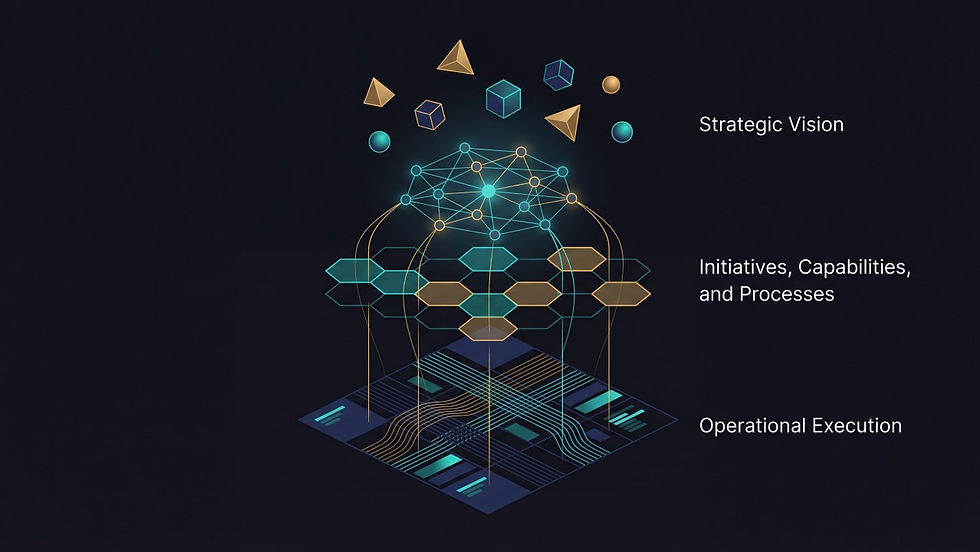
A common language. Without a shared framework, each department speaks its own dialect. The CTrO needs a meta-model that links strategy, capabilities, data, technology, and finance within a coherent framework.
Appropriate governance. Traditional bodies (monthly executive committee meetings, quarterly steering committees) are not enough. The CTrO needs multi-level governance, with varying frequencies depending on the type of decision.
A method that accounts for complexity. Generic frameworks (SAFe, TOGAF, Kotter) each address one aspect of the problem. The CTO needs a comprehensive operational system that integrates them.
This is what we have built with Meridian. Not just another framework, but a transformation governance doctrine - designed for the Chief Transformation Officer.
Gabriel Greenfield est un cabinet de conseil en transformation digitale et intelligence artificielle. Nous aidons les entreprises à orchestrer leurs transformations les plus complexes, avec rigueur méthodologique et ancrage terrain. Méthodologie Meridian | Suggest, Facilitate, Accompany.


Comments