Organizational Transformation in the Age of Intelligence: What the Leading Experts Have to Say
Transformation is no longer a project; it is an ongoing process
Leading consulting firms are unanimous: organizational transformation is no longer a one-off project that you start and then wrap up. It is a constant requirement of the modern business. PwC puts it plainly: when people, processes, and infrastructure are aligned, growth, ROI, and agility follow naturally. But when this triad is out of sync, the cost of a failed transformation is measured in lost market share, eroded margins, and internal mistrust. BCG quantifies the stakes the other way around: having a leader dedicated to transformation improves the success rate by 80%. This is not a governance detail - it is a decisive strategic variable.
The Chief Transformation Officer: A Role Born of Complexity
In light of this reality, the Chief Transformation Officer (CTrO) has gradually established itself as a distinct role in its own right, with a cross-functional mandate and its own legitimacy.
After studying more than 700 transformations and interviewing more than 250 CTrOs, Bain & Company presents the most practical roadmap for the role.
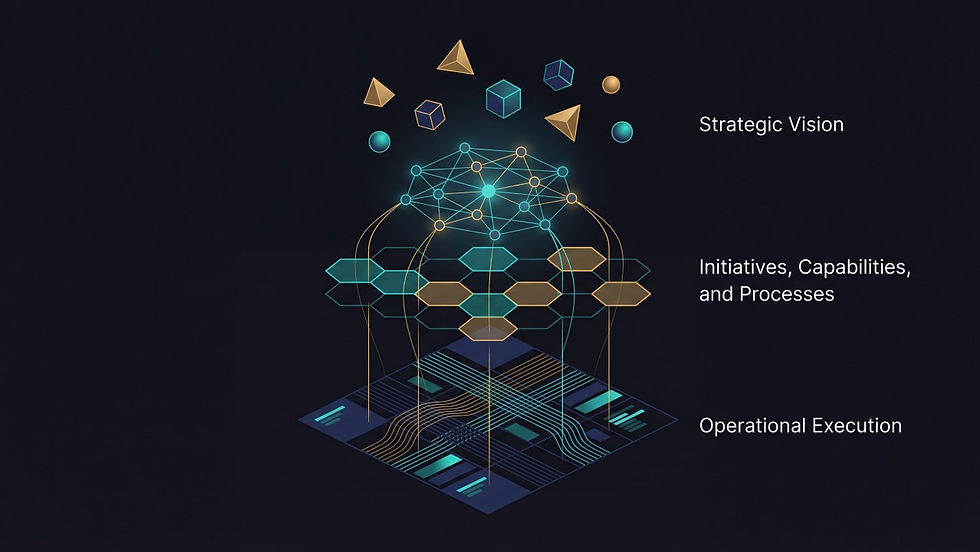
The CTrO is not simply an expanded project manager. He or she plays five distinct roles depending on the phases of the transformation:
○ Strategic architect: sets the direction,
○ Integrator: connects siloed systems,
○ Operator: oversees execution,
○ Coach: develops leadership skills,
○ Controller: measures performance and makes adjustments.
Each role takes center stage at a different point in the cycle, and the most effective CTrOs combine them like the blades of a Swiss Army knife. Our MERIDIAN approach addresses all these roles simultaneously.
The Deloitte 2025 study, the most comprehensive on the subject, outlines the typical profile of this leader: 90% of current CTrOs have led at least three transformation programs in their careers. Experience is non-negotiable. However, it is not always easy to find such a rare gem. This is where MERIDIAN provides comprehensive support.
Furthermore, a strong trend is emerging: companies are moving away from the dual-hat CTrO model, where one person combines operational responsibilities with transformation leadership. They are now appointing full-time executives who are entirely dedicated to the program. Transformation is too complex, too political, and too intense to be managed on the side of another role.
The challenges that define the role
All four sources point to the same areas of friction. The biggest challenge isn’t technological - it’s human. Deloitte identifies change management and talent engagement as the primary budget shortfall, cited as the top concern by executives themselves. Transformations fail when it comes to changing behaviors on a large scale. MERIDIAN incorporates a component dedicated to driving organic, iterative, and responsible change based on Lean Change Management.
PwC adds an often-overlooked dimension: aligning the customer and employee experiences. A transformation that improves internal processes without positively impacting these two dimensions remains incomplete. We will revisit this point very soon in an upcoming article next week.
The CTrO must therefore navigate between rigorous execution and sensitivity to human dynamics - what Bain calls “the art of diplomacy”: avoiding politics, acting as an arbiter between functions, and staying the course without breaking alliances.
AI: Catalyst or Accelerator of Complexity?
McKinsey offers the most insightful perspective on the technological aspect. Its 2025 global study (1,993 respondents, 105 countries) paints a paradoxical picture: 88% of organizations now use AI in at least one function. And yet, only a third of them have truly scaled their programs. The vast majority remain stuck in what McKinsey calls “pilot purgatory”: dozens of promising proofs of concept that never translate into business impact.
The distinction between high-performing organizations and the rest is not technological. It is organizational. “AI high performers” - just 6% of respondents, who attribute more than 5% of their EBIT to AI share a radically different approach: they do not seek to simply add AI to existing processes. Instead, they redesign workflows based on AI logic, rethinking the division of labor between humans and machines. 55% of them report having fundamentally overhauled their processes during AI deployment.
The role of the CTrO thus comes into its own in the era of intelligent transformation.
Ultimately, what these five references collectively outline is a new doctrine of transformation: less linear, more continuous, deeply human in its success factors, and now inseparable from artificial intelligence. The CTrO is not its manager—he is its architect and guardian.
Summary based on BCG, Deloitte (2025 CTrO Study), Bain & Company, PwC, and McKinsey QuantumBlack (State of AI 2025).