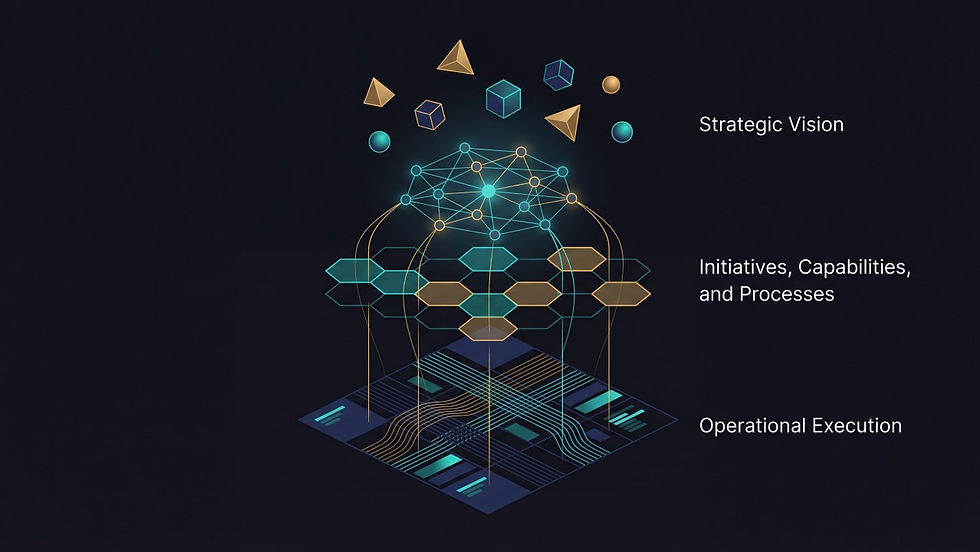
The AI Transformation Office: Methodology and Vision
At a time when every organization wants to “get into AI”, the question is no longer about having access to the right tools. It’s about having the structure in place to turn that access into lasting value.
A simple observation
Most organizations embarking on AI transformation share the same starting point: a patchwork of initiatives with no common direction. An LLM project here, an RPA initiative there, experiments underway in several different directions at once. Each team moves forward on its own; no one is overseeing the big picture. This is a cross-functional leadership issue.
The CIO handles infrastructure and security. The CDO manages data. The HR Director supports change. Everyone does their job—and yet, the transformation remains fragmented. There is a missing role whose explicit mandate is to hold it all together, from strategic ambition to implementation in actual processes.
That is the role of the Chief Transformation Officer - CTrO. This is not a second CIO, and they do not manage the technology infrastructure. Nor are they a Chief AI Officer in the technical sense of the term: they do not oversee LLM architectures or data pipelines. And they are not a program manager responsible for delivering projects on time and within budget.
The CTrO is a change architect. Their role is to ensure alignment between the strategic vision and operational execution, to prioritize initiatives over time, and to ensure that the transformation is truly implemented throughout the organization—not just in executive committee presentations.
The AI Transformation Office: the organization it oversees
At Gabriel Greenfield, we have established the AI Transformation Office as the operational model led by the CTrO. It is built on five pillars, each addressing a real challenge in organizational transformation.
The Governance Pillar is the CTrO’s natural domain. This is where they ensure alignment with the Executive Committee, prioritize the portfolio, and manage the overall ecosystem (partners, suppliers, internal teams). Without this pillar, the transformation lacks executive-level support.
The Methodology Pillar is often the most underestimated, yet one of the most critical. It encompasses the definition of common AI practices, support for human and cultural change, and the dissemination of agile approaches tailored to AI. The CTrO does not lead this pillar alone; they rely on specialized roles and a dedicated methodology: Meridian, formalized by Gabriel Greenfield.
The Roadmap Pillar serves as the transformation dashboard: managing the use case portfolio, consolidated reporting, budget tracking, measuring AI KPIs, and monitoring technical debt. This is where the CTrO exercises their long-term steering responsibility, acting as the guardian and guarantor of the trajectory. They know what is progressing, what is stagnating, and why.
The Support Pillar is the operational heart. Scoping use cases, process modeling, solution architecture, deployment management, and tracking of value created. This is where the transformations that truly reconfigure processes and roles take shape. The CTrO ensures that deployments do not remain pilot projects.
The R&D Monitoring Pillar is the engine of renewal. Tool administration, technology monitoring, and facilitating the community of practice. In a field that evolves on a quarterly basis, this pillar is what prevents the organization from falling structurally behind. The CTrO makes this a priority, not to follow trends for their own sake, but to anticipate disruptions that affect use cases already in production.
Why these five pillars only make sense under unified leadership
Each pillar, taken in isolation, can be assigned to an existing department: Steering to the Executive Committee, Methodology to HR, Roadmap to the CIO, Support to project teams, and Monitoring to an innovation unit. This is, in fact, what most organizations do, and it is precisely why transformation remains fragmented.
The value of the Intelligent Transformation Office does not come from each pillar separately. It comes from their integration under a single mandate. A Roadmap Pillar without a Methodology Pillar is a project portfolio lacking consistency in execution. A Support Pillar without a Steering Pillar is change management in a vacuum. A disconnected Intelligence Pillar is curiosity without impact.
The CTrO is the function that holds these five dimensions together, sees the interdependencies, resolves tensions, and stays the course when the pressures of daily life push us to sacrifice the long term on the altar of immediate results.
What We Believe
Successful AI transformation isn’t about tools. It’s about leadership, methodology, and structure. The CTrO isn’t just another title on the organizational chart. It’s the answer to a question many organizations are asking without yet knowing how to phrase it: Who in our organization is truly responsible for keeping it all together?
Gabriel Greenfield helps organizations structure and steer their AI transformation - from defining the strategic portfolio to operational deployment - using the MERIDIAN Method.